
Betting Odds Conversion and Implied Probability Verification
 Available in US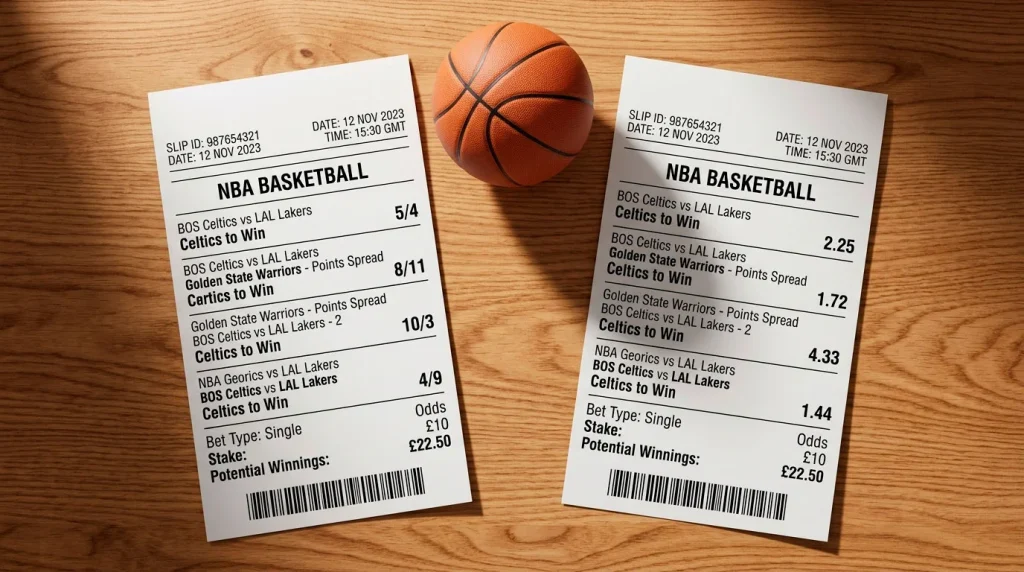
Odds Presentation Systems: Enhancing Algorithmic Betting Accuracy
The first time a friend in the US asked me what odds I was getting on a Celtics game, I said “11/10.” He paused and asked if that was even a number. We were looking at the same bet, priced the same way, but the UK fractional format and the American moneyline format may as well have been different languages. I learned that day that the format you read prices in shapes how you think about them. UK punters carry a specific blind spot from years of fractional fluency, and it costs us money on NBA markets.
NBA betting in the UK runs across two formats simultaneously. Traditional sportsbooks display fractional odds by default. International operators and exchanges display decimal. The two are mathematically equivalent — the same bet priced the same way — but the human brain processes them very differently. Decimal is built for comparison and calculation. Fractional is built for intuition and tradition. For serious NBA punters, the choice of format is not aesthetic. It is operational.
The arithmetic of the two formats
Fractional odds express the profit relative to the stake. A price of 7/4 means you win seven pounds for every four staked. A price of 1/2 means you win one pound for every two staked, which is shorter than even money — a heavy favourite. A price of 5/1 means five pounds profit per pound staked. Total return on a winning bet is profit plus stake. So a £10 bet at 7/4 returns £17.50 plus your £10 back, for £27.50 total.
Decimal odds express the total return per unit staked, including the stake itself. A price of 2.75 means a winning £10 bet returns £27.50 total. The same bet. The same maths. The format just folds the stake-return into the displayed number. A decimal price of 1.50 is the same as fractional 1/2, because 1.50 includes the stake and pays 0.50 in profit. A decimal price of 6.00 is the same as fractional 5/1, because 6.00 includes the stake and pays 5.00 in profit.
The conversion between the two is straightforward. Decimal equals fractional plus 1. So 7/4 becomes 7 divided by 4 plus 1, which is 2.75. 11/10 becomes 1.1 plus 1, which is 2.10. 5/1 becomes 5 plus 1, which is 6.00. Most calculators do this automatically. Most punters do not need to do it by hand. But knowing the conversion is helpful when comparing prices across operators with different default formats.
Why decimal wins for NBA betting
For NBA punters specifically, decimal is the operationally superior format and it is not close. The reasons are practical.
First, implied probability falls out directly. The implied probability of a decimal price is 1 divided by the price. A price of 2.00 implies 50 percent. A price of 1.50 implies 66.7 percent. A price of 3.50 implies 28.6 percent. You can see at a glance whether your forecast for the bet matches what the price is implying. With fractional odds, you have to convert to decimal first, then take the reciprocal. That extra step is a small friction, but it adds up across hundreds of bets per season.
Second, decimal odds compare cleanly across operators. Two operators offering 2.10 versus 2.05 on the same bet show the difference instantly. Two operators offering 11/10 versus 21/20 require mental arithmetic to compare. Across a busy NBA evening with eight games and four operators, the format difference becomes operationally meaningful. Sharp punters bet with the operator offering the best price. Decimal makes “best price” obvious.
Third, parlay multiplication is straightforward in decimal and miserable in fractional. A parlay’s combined decimal price is the product of the individual prices. A three-leg parlay at 1.80, 1.90, and 2.10 has a combined decimal price of 1.80 times 1.90 times 2.10, which is 7.182. The same parlay in fractional would require converting each leg to decimal anyway, then converting back at the end. For modern multi-leg NBA betting, decimal is the only sane format.
The traps that fractional thinking creates
UK punters who think exclusively in fractional odds carry two specific blind spots in NBA markets.
The first is misreading short prices. A heavy NBA favourite at fractional 1/5 implies an 83.3 percent win probability. Many UK punters look at 1/5 and intuitively think “almost certain — easy money.” In decimal, the same bet is 1.20. Looking at a 1.20 price, the brain processes “I’m paying a lot for only 20 percent return.” That accurate processing is harder to do at 1/5. The fractional format hides the small return behind the appearance of inevitability.
The second is misreading long prices. A genuine value underdog at fractional 9/2 implies 18.2 percent. In decimal, that’s 5.50. The decimal display makes the underdog feel like a long shot you’d need to be confident about. The fractional display lets you think “9/2, that’s reasonable, I’ll have a flutter.” The friction of decimal is a discipline filter. Fractional removes the friction, which means it removes the discipline.
The third trap is sizing. When prices are displayed in fractional, punters tend to size by gut. When prices are displayed in decimal, sizing tends to follow expected-value reasoning more naturally. The 1.20 favourite earns a small Kelly stake. The 5.50 underdog earns a smaller one. Both decisions are easier to make in decimal because the maths is one step closer to the screen.
Working in decimal: practical setup
If you are betting NBA seriously in the UK, the first operational move is to switch your account display to decimal. Every UK-licensed operator allows this in the account settings. Once your default is decimal, every price you see is one step closer to its implied probability and one step easier to compare.
The second move is to keep a small reference of common conversions in your head. Decimal 1.50 equals 67 percent. 1.80 equals 56 percent. 2.00 equals 50 percent. 2.20 equals 45 percent. 2.50 equals 40 percent. 3.00 equals 33 percent. 4.00 equals 25 percent. 5.00 equals 20 percent. 10.00 equals 10 percent. Those nine reference points cover the vast majority of NBA markets. Once they are anchored in memory, you can read any line and know its implied probability within a second.
The third move is to do all your CLV tracking in decimal. The arithmetic of CLV — comparing your entry price’s implied probability to the closing price’s implied probability — is much cleaner in decimal. Tracking CLV in fractional is masochism. Tracking in decimal is mechanical. The CLV framework is the most important measurement in NBA betting, and it works hand-in-hand with the decimal format. The two together are the operational floor of any serious NBA betting practice.
The case for fractional and why it loses
The case for fractional odds is cultural and intuitive. Generations of British punters grew up reading horse racing prices in fractional. The format has tradition, familiarity, and a kind of romantic shorthand. 5/1 sounds like a number you could win something on. 6.00 sounds like a calculation.
For sports where the price ranges are wide and the bets are casual — horse racing, Premier League outright winners, football accumulators — fractional carries the cultural weight and the operational drag is small. For NBA specifically, the bet ranges are narrower, the markets are more numerous, and the cross-operator comparison is more frequent. Every operational advantage compounds across hundreds of bets per season. Fractional’s romance does not survive the maths.
The clean recommendation is this. Keep fractional for the bets where the format genuinely adds something — horse races at the Saturday afternoon meeting, the occasional outright on the Premier League. Use decimal for everything in NBA. The format change alone will make your prices easier to read, your CLV easier to track, and your decisions slightly more disciplined. It costs nothing and saves hundreds of small frictions across a season. That is the trade that wins.
Can I switch between fractional and decimal on a UK NBA operator?
Yes, every UK-licensed operator provides a format toggle in account settings, usually under preferences or display options. The change applies across all sports markets and is reversible. There"s no penalty for switching or switching back.
Which format do professional NBA punters use?
Overwhelmingly decimal. The arithmetic of implied probability, expected value, and parlay multiplication is much cleaner in decimal than in fractional. Tracking closing line value, in particular, is far simpler when prices are already in decimal.
Does the format affect the actual bet?
No, fractional and decimal are mathematically identical representations of the same price. 7/4 and 2.75 are the same bet with the same return. The format only affects how you read and process the price, not the bet itself. The operational case for decimal is about comprehension speed and comparison ease.
Articles
Created by the "NBA Stats For Betting" editorial team.
