
Why the NBA Restricts Two-Way Player Props
 Available in US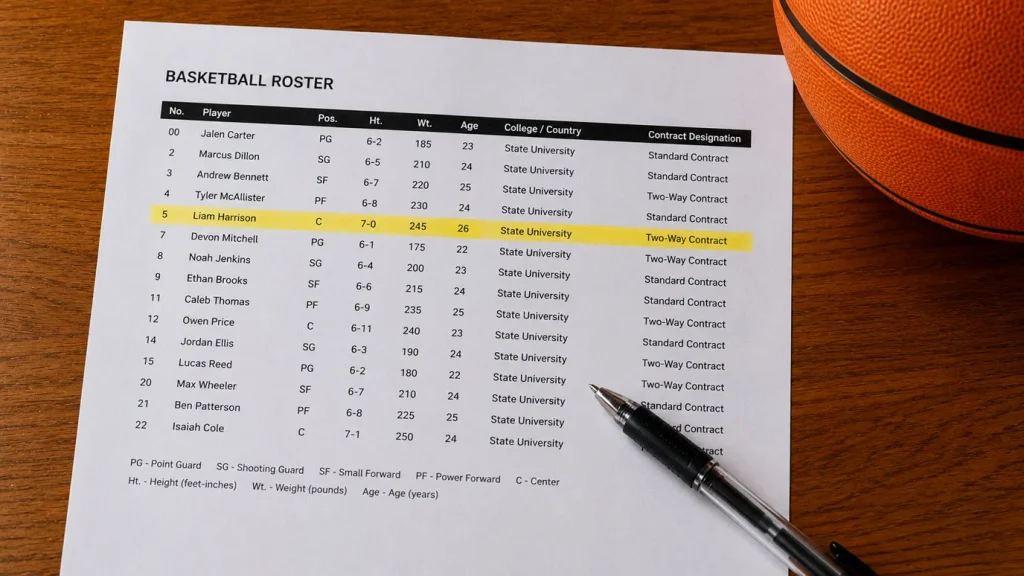
The category that disappeared overnight
I used to bet two-way player props as a small side hobby. There was something appealing about the unfamiliar names, the high variance, and the occasional sharp opportunity when a two-way player got called up unexpectedly. Then, around the middle of 2024, the markets started disappearing. First at one US operator. Then at another. Then across the UK-licensed landscape. By the end of that year, two-way player props had effectively vanished from major operator boards. The decision was deliberate, and the reasoning is structural. Two-way contracts create a specific kind of betting market vulnerability, and after the Jontay Porter case, the operators decided the risk was not worth carrying.
The disappearance is one of those quiet changes that punters either notice or do not, depending on whether they ever bet that category. The lesson, though, is broader than the missing markets. It is about how betting market design works when player roles, contract types, and information asymmetries combine in particular ways. This article walks through what two-way contracts are, why their prop markets carried structural risk, and what the restriction tells us about the broader integrity framework now operating across NBA betting.
What a two-way contract actually is
A two-way contract in the modern NBA is a specific roster designation, introduced in 2017 and expanded since. A player on a two-way deal splits time between the NBA team’s main roster and its G League affiliate, with limited NBA game appearances and a different salary structure than a standard NBA contract. Each NBA team can carry up to three two-way players in addition to its 15-man standard roster.
The structural purpose is developmental. Two-way contracts let teams keep prospects on hand for G League development while making them available for NBA call-ups when needed. The contracts are short-term, the players are usually young or unproven, and the NBA playing time varies wildly. Some two-way players get extended NBA stretches. Others appear in single games as injury fillers. A few break through to standard contracts. Most do not.
From a betting perspective, two-way players have several distinctive features. Their NBA stats are sparse. Their playing time is unpredictable. Their performance is highly variable from game to game. The baseline data needed to price prop markets accurately is limited. And the player’s individual control over whether they enter the game, how long they stay, and how aggressively they play is meaningful in a way that does not apply to established starters.
The mathematical problem with low-volume prop markets
The core mathematical issue with two-way player props is that they sit in a region of the market where small absolute changes in performance produce binary outcomes on the line.
Consider a two-way player called up for a single game. Their season scoring average is 3.5 points. The operator opens a prop at 3.5 points. The implied probability on each side is roughly 50 percent. For the under to clear, the player needs to score 3 or fewer. For the over to clear, they need to score 4 or more. The difference between cashing the over and cashing the under is one made basket. A single shot. A single play. A single rotation decision by the coach.
This kind of binary sensitivity is the prop market designer’s nightmare. The variance is so sharp that random fluctuations dominate the signal. Worse, the underlying decisions that determine the outcome are made by a small number of people — the coach choosing playing time, the player choosing how to allocate their limited minutes. The information density per actor is high, and the information is private. Outside observers see what happened after the fact. Insiders know what is going to happen before it does.
This is not a flaw in two-way players. It is a flaw in trying to price prop markets on outcomes that are this sensitive to private information. Major-minutes players have hundreds of touches per game, multiple coaches and assistants involved in playing-time decisions, and a long enough sample size of plays that no single decision can flip the prop outcome. Two-way players have neither the volume nor the public visibility needed for stable pricing.
The Porter case and the structural response
The Jontay Porter case made the abstract vulnerability concrete. Porter was a two-way player whose limited NBA appearances meant his prop markets were thin, his playing time was at his discretion to a meaningful degree, and the variance on his stat lines was sharp. The manipulation pattern that emerged — disclosing health information, exiting games early, taking advantage of pre-game prop bets on his unders — was the exact failure mode that the structural analysis predicted.
The league’s response, beyond the lifetime ban on Porter, was to engage with operators on prop market design. The framework that emerged is straightforward. Markets on players whose individual decisions can meaningfully control outcome variance are restricted or removed. Two-way contract players, by virtue of their contract type and the limited minutes that characterise it, fall squarely into this category.
The operational implementation across UK and US operators has been quick. By late 2024, major operators had removed two-way player markets across all but the highest-minutes call-ups. By mid-2025, the restrictions were industry standard. UK-licensed operators followed the same path, partly because the UKGC framework encouraged it and partly because the operators’ own integrity teams identified the same risks.
The information asymmetry argument
The deeper argument for the restrictions sits in the information economics of prop markets. A prop market works when the information needed to price it accurately is available to the operator at something close to the same quality the most informed bettor has. When the operator’s information is materially worse than insider information, the market is structurally unsafe for the operator and for the uninformed public bettors.
For major-minutes players, the relevant information is largely public. Playing time is predictable. Coaching tendencies are scouted. Performance baselines are stable. The operator’s model and the sharp punter’s model converge on similar prices, and the bookmaker margin captures the operator’s profit. The system works.
For two-way players, the relevant information is largely private. Playing time is decided in the moment, sometimes by the player’s own communication of fitness. Performance baselines are unstable. The operator’s model is guessing. The sharp punter’s model is also guessing, but the operator does not know whether the punter is guessing or knowing. Concentrated bet activity becomes ambiguous — it might be a sharp punter who has read the situation correctly, or it might be insider activity. Distinguishing the two requires investigation, and the operator’s economics do not support investigation of every two-way player prop.
The clean solution is to remove the markets that produce these ambiguities. The exposure goes to zero. The integrity surface area shrinks. The remaining prop markets are the ones where information economics work — major-minutes players with stable baselines and public visibility.
What this means for UK NBA punters
The practical effect on UK punters is that prop bet boards have become slightly less crowded but materially safer. The markets that exist are the markets where pricing is reasonable, surveillance is meaningful, and information asymmetries are bounded.
The slight loss of betting variety is real but, on reflection, mostly a feature. The two-way player props that disappeared were not, in retrospect, markets that produced consistent edges for sharp punters. They were markets where high variance produced occasional wins for everyone, alongside occasional structural losses to insiders. The expected value distribution was wide and noisy. The disciplined response is to bet the markets where expected value is calculable and the variance is bounded — which is exactly the markets that remain.
For punters who specifically enjoyed the two-way player territory, the practical adaptation is to look for similar variance profiles in markets that remain available. Mid-rotation players with unstable minutes are the next-closest category, though their props are more cleanly priced because the operators do have meaningful data on them. Garbage-time-dependent stat lines (third-string minute thresholds) sometimes carry similar variance characteristics. The skill is in finding the residual high-variance situations within the integrity-protected market structure.
The broader lesson is that betting market design is an ongoing conversation between leagues, operators, and regulators. The Porter case shifted the conversation decisively in 2024. The markets that exist today reflect the post-Porter consensus on what is safe to offer. The full anatomy of the Porter case is the structural foundation of every change that followed, and understanding it is the cleanest way to read why certain markets exist, why others have disappeared, and what the operators are protecting against when they refuse to price the bets you might still want to make.
What is an NBA two-way contract?
A two-way contract is a roster designation that lets a player split time between the NBA team"s main roster and its G League affiliate. Two-way players have limited NBA playing time and a different salary structure than standard contracts. Each NBA team can carry up to three two-way players in addition to its 15-man standard roster.
Why don"t operators offer props on two-way players?
The mathematical sensitivity of prop lines on low-volume players, combined with private information about playing time and fitness, creates structural integrity risk. After the Jontay Porter case in 2024, operators across the UK and US largely removed two-way player prop markets to reduce the manipulation exposure.
Will two-way player props return?
Unlikely in their previous form. The integrity infrastructure that has been built since 2024 makes the markets economically unattractive to operators, and the regulatory framework discourages them. If they return, it would likely be with stricter limits, smaller stakes, and tighter surveillance than the pre-2024 versions.
Articles
Created by the "NBA Stats For Betting" editorial team.
