
Moneyline Valuation Systems and Favorite Traps Avoidance
 Available in US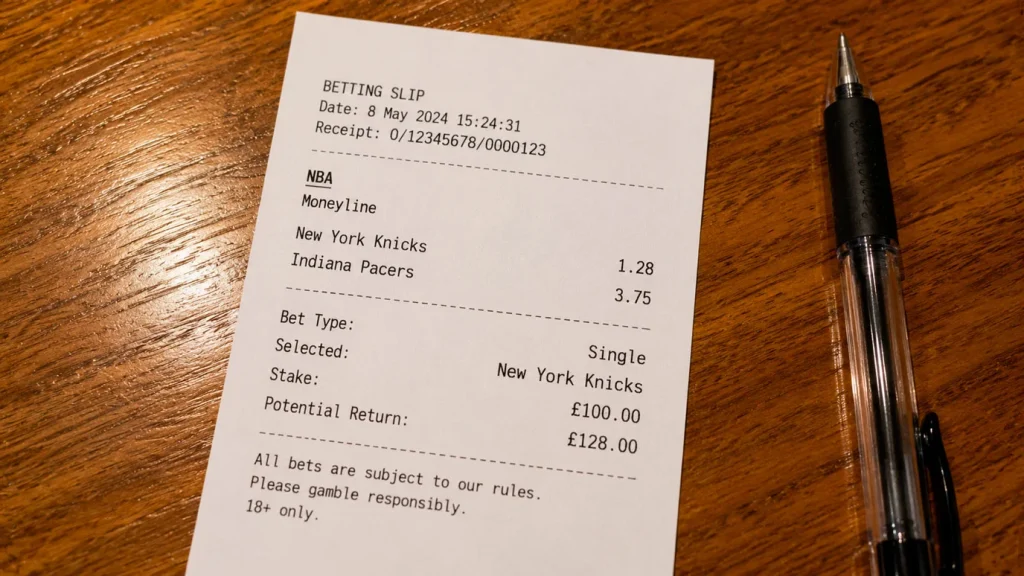
Chalk Selection Hazards: Auditing Low-Yield Favourites Safely
Every NBA betting season has the same conversation in some corner of the internet. A team is priced at 1.15 to win. Someone says “easy money, just back it.” Three games later, that team has lost two of three as a short favourite, and the same voice has gone quiet. I have run the numbers on heavy-favourite moneylines across multiple seasons, and the answer is consistent. Without a specific reason to think the market has mispriced the matchup, blanket backing heavy favourites is a slow, certain way to lose money.
The trap is psychological more than mathematical. A heavy favourite feels safe because the implied win probability is high. The price reflects that implied probability accurately most of the time. To beat a market that is pricing favourites correctly, you need either an information edge or a structural edge. Treating short odds as automatic value is neither. This article unpacks where the genuine edges on NBA moneyline favourites actually live, and how to size them when you find them.
Reading moneyline prices in decimal odds
UK NBA markets quote in both fractional and decimal formats. Decimal is cleaner for moneyline analysis because the implied probability falls out directly. A decimal price of 1.20 implies a 1 divided by 1.20 probability, which is 83.3 percent. A price of 1.50 implies 66.7 percent. A price of 1.85 implies 54.1 percent. Add the implied probabilities for both sides of any NBA moneyline and you get a number above 100 percent. The excess is the bookmaker’s margin.
The margin on NBA moneylines is typically around 4 to 6 percent on heavy-favourite matchups and slightly tighter on close games. That margin is the structural drag you fight against every time you place a moneyline bet. A heavy favourite priced at 1.20 has a true win probability slightly below the implied 83.3 percent — perhaps 81 or 82 percent after stripping the margin. If you blindly back that favourite over hundreds of bets, you lose the margin slowly and steadily. The favourite winning at 81 percent is not the same as the favourite paying 1.20.
This is why moneyline strategy for favourites cannot be “back the favourite.” It has to be “back the favourite when I think the true win probability is higher than the implied probability after margin.” That’s a much narrower decision, and it requires you to have a forecast of your own. The forecast is the bet. The price is the test.
Where heavy-favourite mispricings actually appear
Three situations produce genuine value on heavy-favourite NBA moneylines.
The first is when public money has driven the underdog price down ahead of a high-profile matchup. Star-driven NBA games, especially nationally televised primetime games, attract recreational money on both sides. When the public bets the underdog because the underdog has a marquee player, the line on the favourite can drift to a price that overcompensates. A favourite priced at 1.40 in a market with public money on the dog might actually deserve 1.30. The gap is your edge.
The second is when the favourite has played poorly in a small sample, has been overreacted to, and is still the better team on the inputs that matter. Net rating, offensive rating, and defensive rating change slowly over a season. A team’s actual quality is reflected in those rolling numbers, not in the last three games. When a heavy-favourite’s price has drifted upward because of recent results, but their underlying ratings still justify the original line, the inflated price is the edge.
The third is rest and travel mismatches that the line has not fully absorbed. Home court advantage in 2025-26 is averaging 54.4 percent, the lowest figure recorded in seven decades, but the variance around that average is large. Oklahoma City has been winning 35 of 41 home games for an 85.4 percent home win rate, while Washington has won just 8 of 40 for a 20 percent home rate. When a home favourite belongs to the elite home-court tier and the line does not fully reflect that, the moneyline is undervalued. The gap is your edge.
The maths of parlay-resistance
One of the most common ways UK punters destroy moneyline value is by parlaying multiple heavy favourites. The intuition is that “they’re all likely to win, so combining them gives a decent return.” The maths says otherwise.
If you parlay four favourites each priced at 1.30, your combined decimal price is 1.30 to the fourth power, which is roughly 2.86. The implied win probability of the parlay is 1 divided by 2.86, or 35 percent. The combined true win probability, assuming each favourite has an 80 percent true chance (1.25 fair price), is 0.80 to the fourth power, which is 40.96 percent. So you are betting a parlay with a 41 percent true win rate at a price implying 35 percent. The 6-point gap is your expected edge — but each individual leg is also being hit with the book’s margin, and parlaying compounds that margin geometrically.
The clean version: if you have a 2 percent edge on each leg of a four-leg favourite parlay, your combined edge after margin is closer to 1 percent than 8 percent, because the margins compound. You are not adding edges, you are multiplying them through a thicker margin filter. For most punters the result is that favourite parlays are a much worse bet than single moneylines, even though they feel safer.
Sizing favourite bets with the Kelly criterion
Bet sizing on moneyline favourites is where most punters give back any edge they have managed to find. The temptation with a high-probability bet is to risk more, because winning seems likely. The maths of expected value says the opposite. You should risk less of your bankroll on a tight favourite for two reasons. First, the return per unit risked is small. Second, the variance of a heavy favourite is bounded — they either win small or lose catastrophically.
The Kelly criterion is the cleanest sizing formula. It is the fraction of your bankroll to bet that maximises long-term growth. For a moneyline favourite the formula reduces to: stake proportion equals edge divided by net odds. If you have a 2 percent edge on a 1.30 favourite, your Kelly stake is 0.02 divided by 0.30, which is 6.7 percent of bankroll. Most professionals use a fraction of full Kelly (quarter-Kelly or half-Kelly) to account for forecast error. A quarter-Kelly stake on that bet would be about 1.7 percent of bankroll.
This is why disciplined punters bet single units on each moneyline favourite they find value on, rather than scaling up to “guaranteed-feeling” sizes. The variance smoothing comes from bet frequency, not bet size. The broader context here, from a Lancet Public Health Commission analysis of modern gambling, is that digitalisation has transformed the production and operation of commercial gambling and built strong partnerships in media and social media, providing operators with marketing opportunities to huge new audiences. The pressure to bet more, bet bigger, and bet faster is environmental. Disciplined sizing is the defence.
The road test for any favourite bet
The final question to ask before backing any NBA moneyline favourite is whether the bet still makes sense if the favourite is on the road. Home court advantage has thinned in 2025-26 but it is still real. A team priced at 1.25 to win at home might be priced at 1.45 to win the same matchup on the road. If you are backing a heavy favourite, ensure you understand which side of that price you are getting.
The road favourite test gets sharper for back-to-back situations. A road favourite playing on the second leg of a back-to-back is a structural underperformer. Both fatigue and travel hit at once. The line typically adjusts for this, but not always fully, especially when the public is betting the marquee road team. Reading the rest calendar before reading the price is the simplest filter for separating a fair favourite from a fool’s bet. The closing line value workflow is what tells you, over a season, whether your favourite picks are actually beating the close or just feeling like they should. The favourite bets that consistently move toward the close in your favour are the ones with real edges. The favourite bets that consistently move away from the close are exposing where your forecasts are weak.
Is it ever worth backing a heavy NBA favourite?
Only when you have a specific reason to believe the price overestimates the underdog or underestimates the favourite. Blanket backing of heavy favourites is a slow loss because the bookmaker"s margin is built into every line. The bet needs to be the gap between your forecast and the implied probability, not the price alone.
What price is considered a heavy favourite?
In decimal terms, anything from 1.10 to roughly 1.40 is heavy favourite territory. Below 1.10 the implied probability is so high that even small forecast errors swallow any edge. Above 1.40 the price is closer to medium favourite range where the maths of risk and reward starts to balance out.
How much of my bankroll should I risk on a 1.20 favourite?
Far less than instinct suggests. A 1.20 favourite pays 20 percent net. Even with a small genuine edge, Kelly criterion sizing produces stakes of one to three percent of bankroll. The temptation to risk more comes from the high implied probability, but the limited upside means the variance is sharp and the optimal stake is small.
Articles
Created by the "NBA Stats For Betting" editorial team.
