
Travel Direction Impact and Spread Valuation Formulations
 Available in US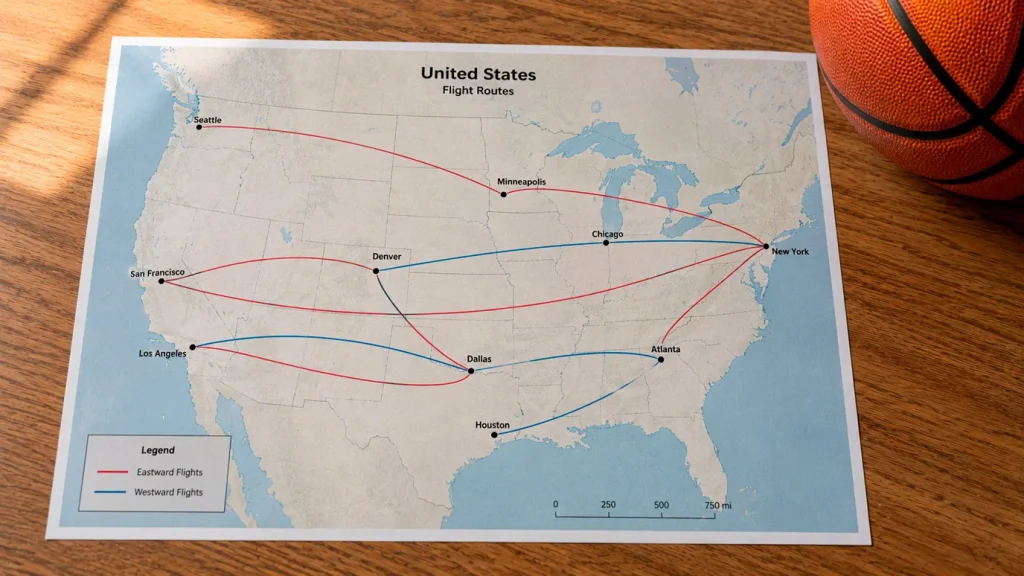
Circadian Rhythm Distortion vs Distance Traveled Calculations
The first time I read the Charest et al. paper on NBA circadian disruption, I had been betting the league for four years and I had been wrong about travel for all four. I treated distance as the variable that mattered. Long flight, long disadvantage; short flight, short disadvantage. The research showed me something I had not considered: distance is secondary to direction. A team flying the same number of miles east versus west experiences measurably different fatigue effects, and the win-rate evidence in the dataset is large enough to bet on.
This article is the long-form version of the read. For UK punters watching late-night NBA games, the time-zone considerations are doubly relevant — we are also reading these games against our own body clocks. But the core insight is about the teams on the floor: eastward travel produces measurably better outcomes than westward travel, and the betting market has been slow to price the asymmetry consistently. Reading the schedule through this lens has given me one of the most durable edges of the last several seasons.
Crossing multiple time zones disrupts circadian rhythms, which directly leads to increased fatigue and lower shooting accuracy during road games.
The Charest et al. dataset and the key numbers
The work that anchored my thinking on this came from Jonathan Charest, Charles Samuels, Célyne Bastien, Doug Lawson and Michael Grandner, published in the Journal of Clinical Sleep Medicine in 2021. They analysed NBA back-to-back games across seven seasons from 2013 to 2020 and split the data by direction of travel. The result was clean enough to remember without notes.
Teams travelling eastward for a back-to-back won 44.51 percent of those games. Teams travelling westward for a back-to-back won 40.83 percent. The gap of nearly four percentage points is substantial in a league where most betting edges are measured in fractions of a percent. In the authors’ own framing, regardless of the back-to-back sequence, the team travelling eastward had a winning percentage of 44.51 percent compared with 40.83 percent when teams travelled westward. That is the headline number that any punter modelling NBA games against the schedule should be carrying around in their head.
The numbers come from a back-to-back specific sample, which means they isolate the situation where travel fatigue is most acute. But the underlying mechanism — circadian disruption affects performance asymmetrically depending on direction — applies more broadly. A team on a single road game after westward travel, even with a normal rest day, still operates against a partially-shifted body clock. The effect is smaller than in the back-to-back sample, but it is real and it adds up over a road trip.
Why eastward travel is harder
The asymmetry is not a quirk of the data. It is a function of how human circadian rhythms work, and the chronobiology research outside basketball points in the same direction.
The dominant explanation is that the human body clock runs slightly longer than 24 hours under controlled conditions, and re-entraining it forward — making it think it is later than it currently feels — is harder than re-entraining it backward. Westward travel asks the body to stay up later than it would otherwise want to. The body finds that easier. Eastward travel asks the body to get up earlier than it would otherwise want to. The body resists. Sleep latency increases, sleep quality drops, daytime alertness suffers. For a basketball player asked to perform at peak intensity within 24 hours of the flight, the eastward direction is the harder ask.
But here is the twist that matters for NBA betting. The Charest et al. results show that eastward-travelling teams win more, not less. The reason is that NBA games are played in the evening local time at the destination. A team flying eastward effectively gets a later tip-off relative to its body clock — its players are tipping off when their bodies feel it is much later in the evening, which biologically corresponds to peak physical readiness. A team flying westward tips off when its players’ bodies feel it is too early — their afternoon physical performance window has not yet arrived. The travel itself is harder eastward, but the game timing relative to the body clock is more favourable eastward. The net effect — the only one that matters for betting — is the favourable game timing.
Where travel direction creates spread edges
This is the practical section. The Charest et al. baseline of 44.51 percent versus 40.83 percent translates, very roughly, into a spread-equivalent edge of about one to one and a half points for the eastward-travelling team in a back-to-back situation, relative to a schedule-neutral matchup. The market sometimes captures this. Often it does not.
The cleanest setup is a road team on the second night of a back-to-back, having flown westward into the matchup. This is the maximum-disadvantage version of the travel situation, layered on top of the standard back-to-back fatigue effect. The book’s standard back-to-back adjustment, typically around two and a half points by spread, captures part of the picture. The directional component is often not separately adjusted. A westward-travelling back-to-back team is worth fading another half-point to a full point beyond the standard back-to-back adjustment.
The mirror — a road team on the second night of a back-to-back, having flown eastward — is the spot where the market often overprices the disadvantage. The fatigue baseline is real, but the directional component is helping these teams, not hurting them. A book that applies a flat back-to-back adjustment without separating direction is offering an inflated spread on the road team. This is one of the rare situations in the NBA market where backing a tired road team has a structural edge.
Travel direction also stacks with rest and travel volume in more subtle ways than a single back-to-back captures. The deeper fatigue and sleep research covers the cumulative version — how a multi-game road trip with mixed directions affects performance differently than a same-direction trip — because the body’s circadian state at the end of a road trip is the sum of every direction shift across the trip, not just the most recent one.
Factor these travel disadvantages into your predictive models using the resources provided by NBA Stats For Betting.
Three honest caveats
The Charest et al. result is robust, but it is not a free edge. Three things to watch.
The first is sample. The 44.51 vs 40.83 percent split came from seven seasons. The 2020-2026 period has seen changes in travel logistics, charter scheduling and team-level recovery investment that may have shrunk the directional gap slightly. The direction of the asymmetry remains the same; the magnitude may have softened.
The second is tip-off time. Most NBA games tip between 19:00 and 22:00 local time at the destination, which is when the directional asymmetry is most active. Afternoon games — the rare matinee or holiday-slate game — flip some of the dynamics, because the body-clock advantage for eastward travel depends on the late local tip-off. For afternoon games, the eastward edge is reduced.
The third is the interaction with international travel — including future scenarios where teams might fly across the Atlantic for NBA Europe-related fixtures. The Charest et al. data is exclusively North American intra-continental travel. Trans-Atlantic flights produce circadian disruption an order of magnitude larger than anything in the existing dataset, and the effects on performance windows have not been tested in NBA play. As more international NBA fixtures appear in the coming years, this is research worth watching.
Is east-to-west or west-to-east the harder direction?
Westward travel produces worse NBA performance for teams in back-to-back situations. The 44.51 percent eastward win rate beats the 40.83 percent westward win rate by nearly four points. The asymmetry is driven by how local game-time matches up against the players" body clocks.
Does the time of tip-off change the travel effect?
Yes. The directional asymmetry is strongest for typical evening tip-offs (19:00 to 22:00 local time). For afternoon games, the body-clock advantage from eastward travel is reduced because the local game time is earlier relative to the players" biological readiness window.
How does international NBA travel (e.g., to London) factor in?
The existing research is exclusively North American. Trans-Atlantic travel produces circadian disruption far larger than any flight in the Charest et al. dataset. As more international NBA fixtures appear in coming seasons, the directional effects are likely to be even more pronounced, though the empirical NBA-specific research has not yet been built.
Articles
Prepared by the NBA Stats For Betting editorial staff.
