
Licensed UK Sportsbooks and Basketball Market Depth Reviews
 Available in US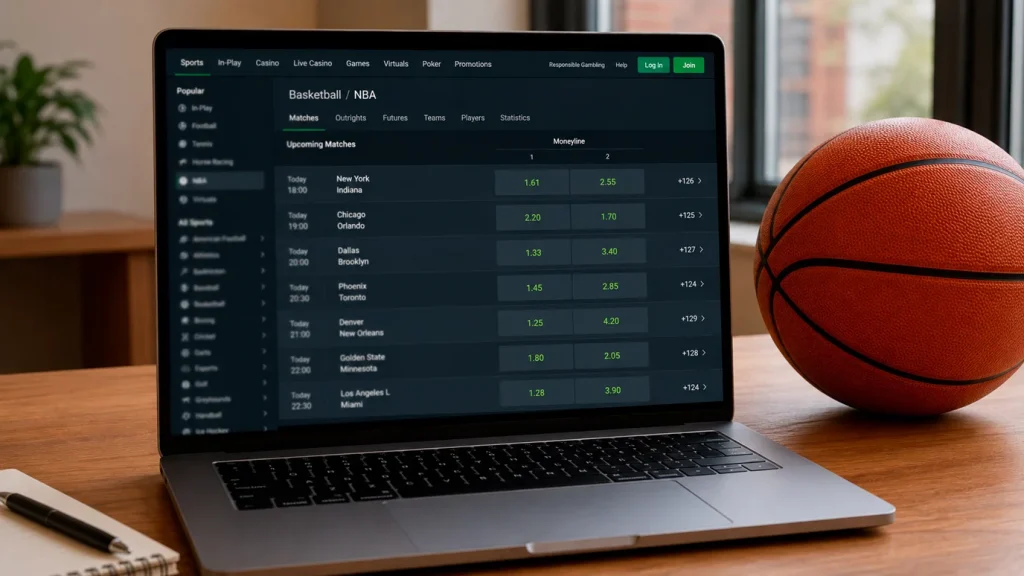
Regulated Market Progression: Expanded Wagering Inventories for Punters
Five years ago, getting decent NBA coverage from a UK-licensed bookmaker meant tipping off the night with three operators open in browser tabs and accepting that two of them would only price the main markets. The depth was poor, the prop coverage was thin, and the live trading desks closed half the secondary markets when the action got busy. That has changed. NBA viewership on Sky Sports rose by 58 percent in the 2021-22 season alone, and the operators followed the audience.
Today, the major UK-licensed operators run NBA markets that are competitive in breadth, depth, and pricing with most international books. The market structure is different from the football-dominated UK landscape, with its own rhythms, its own busy hours, and its own structural quirks. For a UK NBA punter, understanding how the licensed market actually works is the foundation of building a bankroll-preserving betting practice. This article walks through what UK NBA coverage looks like in 2026, what the licensed framework gives you, and where the structural differences from international markets show up in the prices on your screen.
What “UK-licensed” actually means
A UK-licensed bookmaker is an operator authorised by the UK Gambling Commission to offer betting services to UK residents. The licence carries a set of obligations on operators around fair pricing, customer protection, deposit limits, identity verification, and dispute resolution. For NBA betting specifically, the licence means three concrete things.
First, all winnings are paid out tax-free to the punter. The UK abolished betting duty on the customer in 2001 and replaced it with a tax on the operator, which means you keep 100 percent of your winnings on settled bets. This is a significant structural advantage over many international jurisdictions where the punter pays a tax on winnings.
Second, UK operators are required to apply identity verification before paying out significant winnings, and they monitor accounts for problem-gambling signals. These obligations sit lightly on most punters but they exist. Account verification at sign-up and again at large withdrawal points is normal. The processes are usually quick, but they are mandatory and they exist for sound reasons.
Third, dispute resolution is structured. If you have a serious complaint with a UK-licensed operator, there are independent arbitration services available. The protection is not unlimited, but it exists and it is enforceable.
How NBA coverage stacks up across operator tiers
UK-licensed operators split into tiers based on how seriously they take NBA as a market.
The top tier — the operators that have invested in dedicated NBA trading — provides pre-game lines for every game, full prop markets covering points, rebounds, assists, threes, and combinations, live in-play trading throughout each game with multiple in-play markets, and same-game parlay options. Pricing on this tier is generally competitive with the major international books, though margins on secondary markets are sometimes wider.
The middle tier — operators that prioritise football and tennis with NBA as a secondary market — provides solid main-market coverage but thinner prop coverage. The pre-game spread, total, and moneyline are always there. Player props might be limited to points only, or might not exist outside the top games of the night. Live trading might be present but with fewer markets than the top tier.
The lower tier — high-street legacy operators that have moved online — sometimes treats NBA as a tertiary market. Coverage might be limited to the main spread and total on the night’s biggest game. This tier is fine for casual punters who only want to bet a feature game, but it is structurally inadequate for serious NBA betting practice. The depth is not there, and you will frequently find yourself unable to bet the market you want to bet.
Pricing differences across UK operators
The most common mistake among UK NBA punters is using a single operator for all their bets. UK operators differ meaningfully on NBA pricing, and using the best price available is one of the cleaner structural edges in betting practice.
Margins on UK NBA main markets typically run between 3.5 and 5.5 percent. The lower end of that range is at the top-tier operators that compete actively for sharp NBA action. The higher end is at the lower-tier operators that treat NBA as filler. Across a season, betting at 3.5 percent margin versus 5.5 percent margin compounds into roughly 2 percent of your turnover. For a punter wagering £20,000 a season, that’s £400 of preventable loss to operator selection.
Where the price differences sharpen is in secondary and prop markets. A 25.5 points line on a star player might be 1.95/1.95 at one operator and 1.85/2.05 at another. The first operator is charging 5 percent margin. The second is charging 3 percent on one side and giving you 5 percent juice on the other, with the better side of the line depending on which way you want to bet. Sharp punters check three or four operators before placing any prop bet, and they bet at the operator offering the best price on the side they want.
Bonuses, free bets, and what they actually cost
UK-licensed operators compete partly on signup bonuses and ongoing promotions. Free bet matched deposits, enhanced odds on specific markets, and bonus accumulators are common. The headline pitches are designed to attract recreational punters, and the structure is engineered to deliver value to the operator over time.
The maths is honest enough if you read it. A “bet £20, get £20 free” offer typically requires the free bet to be wagered through a minimum number of times before withdrawal. The minimum odds are usually set at 1.50 or higher. The free bet’s stake is not returned with winnings. Each of these conditions reduces the expected value of the bonus. The advertised £20 free bet might have an actual expected value of £8 to £12 depending on the wagering requirements.
The clean reading is that bonuses can be useful for boosting an existing betting practice, but they should not be the reason you choose an operator. Choose your operator based on pricing, market coverage, and reliability. Use any bonus on top of that. The reverse approach — choosing operators based on bonuses, then living with their worse pricing — costs more in lost margin than the bonus is worth.
The structural advantages UK punters have
UK punters operate in a market that has matured significantly for NBA, and the structural setup carries genuine advantages worth understanding.
The time zone advantage is the biggest. Most NBA games tip between midnight and 3am UK time. The final injury reports drop at 9:30pm UK time. That window — between 9:30pm and tip-off — is when the lines have absorbed the news but the bulk of US recreational money has not yet hit. UK punters who pay attention in their evening can get prices that move toward them by the time the US East Coast wakes up and starts betting in earnest.
The tax structure is the second. Winnings being tax-free on the punter’s side means your bankroll compounds without leakage. In contrast, US punters playing in regulated states pay tax on winnings above set thresholds, which materially reduces the long-run growth of even a winning bankroll.
The regulation is the third, and the most underappreciated. The UK-licensed market is competitive, regulated, and stable. Operators are obligated to honour bets, pay out promptly, and adhere to fair dealing standards. This is not glamorous but it is structurally important. Punters in unregulated jurisdictions sometimes face operators that delay payouts, void winning bets on technicalities, or simply disappear. The UK licensing framework protects against most of that. The specific UKGC rules that affect NBA bettors are worth understanding in depth, because they shape what you can bet, when, and how — and they are the legal foundation of the structural advantages outlined here.
Do UK punters pay tax on NBA betting winnings?
No. The UK abolished betting duty on the punter in 2001 and replaced it with a tax on the operator. Winnings from UK-licensed bookmakers are paid out tax-free regardless of size. This is a structural advantage compared with many international betting jurisdictions.
How many operators should a serious NBA punter use?
Three to four is the practical target. That number gives enough price coverage to find the best line on most bets without becoming operationally chaotic. Some sharp punters use five or six, but the marginal benefit thins out and account management becomes a job in itself.
Are bonuses worth chasing for NBA betting?
Useful on top of an existing practice but not a reason to choose an operator. Wagering requirements, minimum odds, and stake-return rules reduce the effective value of most bonuses well below the headline figure. Choose your operators on pricing and reliability first.
Articles
Prepared by the NBA Stats For Betting editorial staff.
