
Regulatory Compliance Frameworks and Safe Gambling Protocols
 Available in US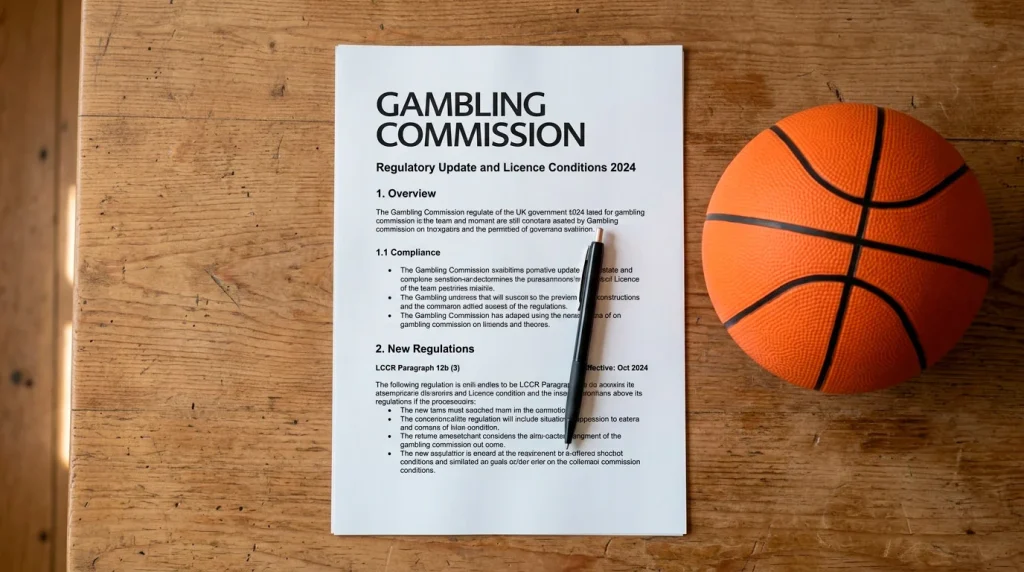
Statutory Enforcement Details: Protecting Account Integrity Under LCCP
A friend of mine had a winning NBA prop bet voided last year because the player took fewer than the qualifying number of minutes. He was furious. He posted about it everywhere. He threatened to leave the operator. Three weeks later, when his account verification triggered an identity check at withdrawal, he was furious again. Both situations are explicitly covered in the UK Gambling Commission’s framework for licensed operators. If he had read the rules — or even the operator’s terms — neither would have been a surprise.
The UKGC framework is the regulatory backbone of NBA betting in the UK. Most punters never engage with it directly, but it shapes everything from what markets exist, to how account verification works, to what happens when a bet outcome is unclear. This article walks through the rules that NBA bettors most often run into, the ones that protect you, the ones that constrain you, and the ones that simply exist as the operational reality of the licensed UK market.
Account verification: KYC and source of funds
Every UK-licensed operator is required to verify the identity of its customers. The framework is Know Your Customer, or KYC. At signup you provide your name, date of birth, and address. The operator verifies these against external databases. For most customers this is invisible — the verification happens in the background and the account opens immediately. For some customers the verification triggers a manual check requiring documents.
The second layer is source-of-funds verification. UK operators must monitor for suspicious financial patterns and request documentation when customer activity passes certain thresholds. For most NBA punters this never comes up. For higher-volume punters or those depositing significant sums, the operator may request bank statements, payslips, or other evidence that your funds come from legitimate sources. This is regulatory obligation, not operator discretion.
The practical timing is the friction point. Verification at signup is normally quick. Verification at first significant withdrawal can take longer, especially if it triggers manual review. The operational mistake is depositing and betting large sums before completing verification, then being held up at withdrawal when you have already mentally spent the winnings. The clean approach is to complete full account verification at the point of signup, before any large deposit, so the documentation is on file before you need to withdraw.
Bet settlement rules and “dead heat” provisions
NBA bet settlement runs on rules that are precise and not always intuitive. Three categories regularly catch out UK punters.
The first is the minimum-minutes rule for player props. Most operators require a player to play a minimum number of minutes (typically five) for a points, rebounds, assists, or threes prop to settle. If the player gets injured early and exits before reaching the minimum, the bet voids and the stake is returned. This is a protection for both sides — it prevents the punter from being unfairly settled on a bet where the player did not have a real opportunity to perform, and it prevents the operator from being arbitraged on injury news.
The second is the abandoned-game rule. If an NBA game is suspended and not completed within a stated window (usually 36 to 72 hours depending on operator), pre-game bets generally void. Bets that were already definitively resolved at the time of suspension (a first-quarter line that had already settled) usually stand. The exact treatment varies by operator and is in their terms. Reading the terms before the rare suspension event is unglamorous but it prevents disputes when the situation arises.
The third is the dead-heat rule for prop markets like “first basket scorer.” If two players score on the same possession (technically impossible in practice, but the rule is published to cover edge cases) or if the market settlement is ambiguous, dead-heat rules apply. Your winnings are reduced proportionally rather than paid in full. This rarely affects NBA bets in practice but it is in the rulebook.
The 2024 UKGC consultation impact on player props
The UKGC has actively reviewed and tightened rules around player prop markets in recent years. The catalyst was a series of integrity incidents in 2024 that highlighted vulnerabilities in low-volume player prop markets — markets on individual players whose stats could be influenced by a single player’s actions. The Jontay Porter case in the US, where a player was banned for life after manipulating his own prop performance, focused attention on similar exposure in UK markets.
The UKGC response has been to encourage operators to restrict or remove markets where integrity risk is concentrated. Two-way player contracts and minimum-minutes players are now generally excluded from prop markets at UK operators. The reasoning is straightforward — a player with minimal court time and low base stats can produce outsized variance on a single play, and that creates an integrity exposure that is hard to police.
For UK NBA punters, this means certain prop markets that exist on international books are not available domestically. A two-way player props market that’s available on a US sportsbook may simply not be offered by a UK-licensed operator. This is a protection, not a restriction — the missing markets are the ones most exposed to manipulation, and their absence reduces the risk that you bet into a compromised market.
Deposit limits, self-exclusion, and responsible gambling
UK operators are required to provide a set of player protection tools. Deposit limits let you cap your daily, weekly, or monthly funding of the account. Loss limits cap your net losses across a period. Time-out functionality lets you suspend the account for 24 hours up to six weeks. Self-exclusion is the strongest version — a binding suspension of access for six months minimum, often via the GAMSTOP scheme which covers all UK-licensed operators.
These tools are there because the regulator recognises gambling harm is a public health issue. A Lancet Public Health Commission analysis observed that digitalisation has transformed the production and operation of commercial gambling, and the industry has built strong partnerships in media and social media, providing operators with marketing opportunities to huge new audiences. The protection tools exist as the regulatory counterweight to that marketing reach. Using them proactively — setting a deposit limit you would never want to exceed even at peak enthusiasm — is one of the cleaner forms of self-discipline.
For NBA punters specifically, late-night betting carries its own risks. Sleep-deprived decisions are worse decisions. The research is unsparing — late-night digital activity has measurable cognitive costs. UK operators offer reality-check pop-ups at intervals, which prompt you to acknowledge how long you have been betting. Enabling these is a small annoyance with a real protective effect. Most professional punters use them.
What changes when you breach the rules
The final practical category is what happens if you fall on the wrong side of operator or UKGC rules.
The most common situation is multi-account holding. UK operators do not permit a customer to hold multiple accounts at the same operator (one customer, one account). Attempting to circumvent betting limits by opening secondary accounts will, when discovered, lead to closure of all accounts and possible forfeiture of balances. This is a rule worth taking seriously.
The second is bonus abuse. Wagering bonuses with the intent to extract value through specific bet patterns (such as opposite bets across multiple operators) is treated as bonus abuse by most operators. Detection methods are sophisticated. Account closures with balance forfeiture are the standard response.
The third is geographic compliance. UK licences cover UK residents. Betting from outside the UK on a UK-licensed account, especially from jurisdictions with their own regulatory regimes, can lead to account suspension. The operators check IP addresses and payment methods. Travelling abroad for a holiday and placing the occasional bet is generally fine; relocating outside the UK and continuing to bet on a UK account is generally not. The clean approach is to follow the residency rules of your account jurisdiction. The broader UK-licensed operator landscape is where these rules play out in practice, and understanding both the rules and the operators is the foundation of a sustainable UK NBA betting practice.
Why was my NBA prop bet voided when the player got injured early?
Most UK operators require a minimum number of minutes (typically five) for player props to settle. If the player exits before the threshold, the bet voids and the stake returns. This is published in the operator"s terms and applies across UK-licensed providers.
Are all UK-licensed operators on GAMSTOP?
Yes. GAMSTOP is the national self-exclusion scheme that all UK-licensed operators are required to support. A single self-exclusion through GAMSTOP applies across every UK-licensed operator simultaneously. The minimum exclusion period is six months and the maximum is five years.
What"s the deposit verification threshold at UK NBA operators?
There"s no single threshold; it varies by operator and customer profile. Source-of-funds requests typically trigger at significant cumulative deposit levels or when patterns suggest funds may not be from declared sources. Completing full verification at signup, before depositing large sums, avoids most withdrawal-time friction.
Articles
Created by the "NBA Stats For Betting" editorial team.
