
Prediction Markets vs UK Sportsbooks (NBA)
 Available in US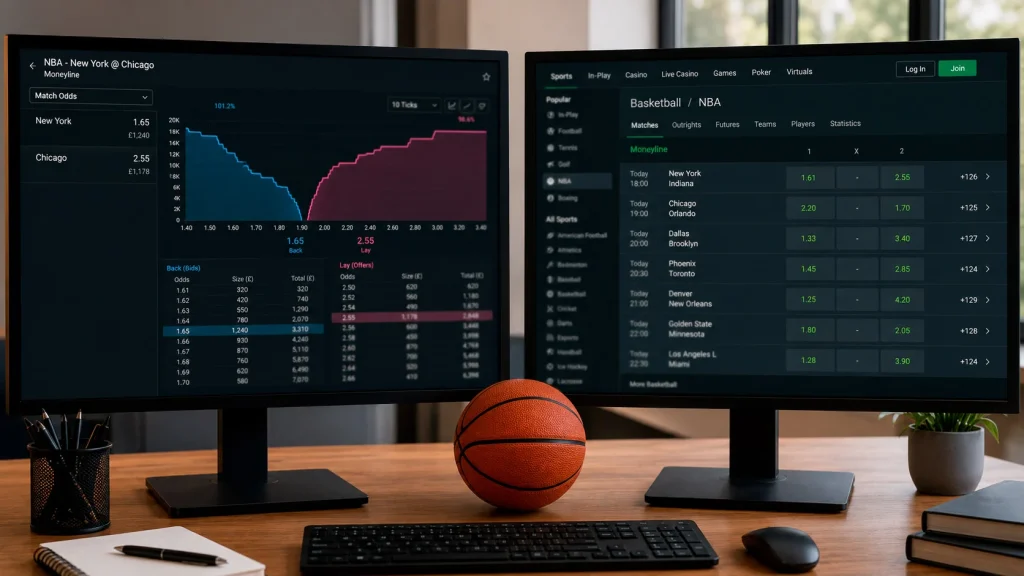
Two routes to the same bet, priced differently
A friend of mine in New York spent the back end of 2024 obsessed with prediction markets. Every time we talked about an NBA game he was on about Polymarket or Kalshi or some other event-contract platform where he was getting prices he claimed were better than any sportsbook he could find. I was sceptical. The platforms looked unfamiliar, the interface was nothing like a UK bet slip, and the underlying mechanics seemed opaque. When I finally sat down and worked through a few examples, the picture became clearer. Prediction markets are not better or worse than UK sportsbooks. They are a structurally different product, and for some NBA bets they offer genuine pricing advantages — while carrying their own costs and trade-offs.
For UK punters considering whether to use prediction markets alongside traditional sportsbook accounts, the analysis is operational, not ideological. The two products are built differently, charge differently, and serve different bet types. This article walks through the mechanical differences, the price differences they create, and where prediction markets are actually useful for NBA betting versus where they are not.
The mechanic that makes prediction markets different
A traditional sportsbook is a bookmaker. The operator sets a line, takes bets on both sides, and profits from the margin between true probability and posted probability. When you bet the Lakers at -4.5, you are betting against the bookmaker, who has priced the line and now has exposure to whichever side wins.
A prediction market is an exchange. Two participants — buyer and seller of a contract — agree to trade a “yes” or “no” position on an outcome. The platform takes a commission rather than a margin. The price of the contract is whatever buyers and sellers have agreed on through their orders. There is no bookmaker setting the line. The line is the result of supply and demand on the platform.
This difference matters because it changes the price formation. A sportsbook line reflects the bookmaker’s forecast plus their margin plus their inventory management. A prediction market line reflects the collective forecast of every participant who has placed an order, weighted by their willingness to put money behind it. In efficient markets, the two converge. In inefficient markets, they diverge in directions that depend on who is participating and what biases each pricing mechanism carries.
Where prediction markets price NBA tighter
Prediction markets often price NBA outcomes more tightly than sportsbooks on three specific categories of bet.
The first is binary outcome markets. Will the Lakers win? Will the over hit? These are clean yes/no questions where the prediction market’s structure (a contract paying out a fixed amount on yes or no) maps directly onto the bet type. The sportsbook equivalent is a moneyline or total, but the sportsbook builds margin into both sides. The prediction market only takes commission from winners. For close-call binary bets, the prediction market’s effective price can be meaningfully better.
The second is long-dated futures. Who will win the NBA Championship? Who will be MVP? These markets reward depth of participation and benefit from many participants having long-horizon views. Sportsbook futures often carry wider margins because the operator has to hedge exposure across the season. Prediction markets price futures more cleanly because the contract structure naturally distributes the long-dated risk across many participants.
The third is event-driven specific outcomes. Will the NBA Finals go to seven games? Will a specific player win Defensive Player of the Year? These markets benefit from prediction market liquidity around well-defined binary questions. Sportsbooks price these but often with thin liquidity and wide margins. Prediction markets sometimes price them more tightly, especially when the contract structure aligns with how participants naturally think about the outcome.
Where UK sportsbooks remain superior
Prediction markets have material limitations that make them poor substitutes for traditional sportsbooks on several major NBA betting categories.
The first is point spreads. A sportsbook can offer Lakers -4.5 at 1.91 with continuous pricing across many half-point increments. Prediction markets struggle to replicate this granularity efficiently. Each spread requires a separate contract, and the liquidity needed to keep each contract priced tightly is rarely there for secondary half-points. The sportsbook’s continuous odds curve is structurally better suited to spread betting than the prediction market’s contract-by-contract approach.
The second is live betting. Sportsbooks run continuous in-play markets with prices that update every second based on game state. Prediction markets generally do not have the liquidity infrastructure to support real-time live betting on NBA games. The contracts that exist are slow-moving and often suspended during fast-paced game action. UK punters who bet live NBA almost exclusively use sportsbooks for this category.
The third is player props on minor players. Prediction markets typically focus on high-volume bet types with broad participant interest. Niche player props — points lines on bench players, rebound props on role players — rarely have liquid prediction market equivalents. The sportsbook’s willingness to price markets without depending on counterparty interest is a real advantage for prop-focused punters.
The fourth, and most importantly for UK punters, is the regulatory framework. UK sportsbooks operate under the UKGC licensing regime. Prediction markets like Polymarket and Kalshi operate under different regulatory frameworks in their home jurisdictions, and UK access to them may or may not be permitted depending on the platform’s licensing approach. Betting outside the UK regulatory framework carries the trade-offs of reduced customer protection, ambiguous legal status, and currency conversion costs.
The commission versus margin maths
The cost structure of prediction markets and sportsbooks differs in ways that affect the long-run economics for different types of punters.
Prediction markets typically charge commission only on winning trades, usually in the range of 1 to 2 percent of net winnings. Some platforms charge maker/taker fees that vary by liquidity provision. The cost structure favours punters with positive expected value, because the commission applies only to wins. If you have negative expected value, you do not pay commission on losses, so the headline cost looks favourable.
Sportsbooks charge margin on every bet at the point of placement. The margin is embedded in the price. You pay it whether you win or lose. A 5 percent margin on a 2.00 odds bet means you are getting 1.95 instead of fair 2.00 — and that gap applies to every bet regardless of outcome.
For positive-EV punters who win 53 percent of bets, the math favours prediction markets. The 1.5 percent commission on winning trades is less than the 5 percent margin paid on every bet. The cost ratio over a year of high-volume betting can be substantial.
For neutral or negative-EV punters, the math favours sportsbooks. The commission is taken only on wins, so a losing punter pays less effective tax through commission than they would through margin, but the structural disadvantage of negative EV is the dominant problem, and switching platforms does not solve it. The cost structure analysis matters most for punters who actually have edges to protect.
The integration question for UK punters
The practical question for UK punters is whether to integrate prediction market betting alongside traditional sportsbook accounts.
The honest answer for most UK punters is no, at least not yet. The regulatory uncertainty around UK access to international prediction markets makes the operational risk meaningful. UK punters who want to bet NBA primarily should do so through UK-licensed sportsbooks where the regulatory protection, tax treatment, and customer service are clear.
For sophisticated UK punters with international access, prediction markets can be a useful supplementary tool for specific bet types — futures and binary outcome markets where the price advantage is meaningful and the regulatory complexity is acceptable. The infrastructure to manage cross-platform accounts, currency conversion, and regulatory compliance is substantial, and only worth building for punters with serious betting practices.
The broader trajectory is interesting. Prediction markets are growing globally, and the technology continues to mature. Some UK-licensed operators have begun exploring exchange-style products that capture some of the prediction market’s benefits within the UK regulatory framework. Whether full-featured prediction markets ever launch under UK licence remains an open question dependent on UKGC policy decisions. The bookmaker hold structure is the relevant comparison point for evaluating prediction market commission economics — the two are different mechanics, but they are both ways of extracting revenue from betting activity, and understanding both is the foundation of evaluating where each makes sense for your betting practice.
Are prediction markets legal for UK punters?
The legality depends on the specific platform"s regulatory status and how UK access is managed. Some prediction markets are not licensed to accept UK customers; others operate under different international frameworks. UK punters should verify the regulatory status of any prediction market before depositing funds.
Do prediction markets offer better NBA prices than UK sportsbooks?
For binary outcome markets and long-dated futures, often yes. For point spreads, live betting, and niche player props, generally no. The two products have different structural strengths and the comparison depends on which type of bet you want to make.
What"s the commission cost on a typical prediction market?
Typically 1 to 2 percent of net winnings, with some platforms using maker/taker fee structures that vary by liquidity provision. The cost is taken on wins rather than at the point of placing the bet, which differs structurally from sportsbook margin charged on every wager.
Articles
Prepared by the NBA Stats For Betting editorial staff.
