
Multi-Leg Bet Compounding Mathematics and SGP Correlations
 Available in US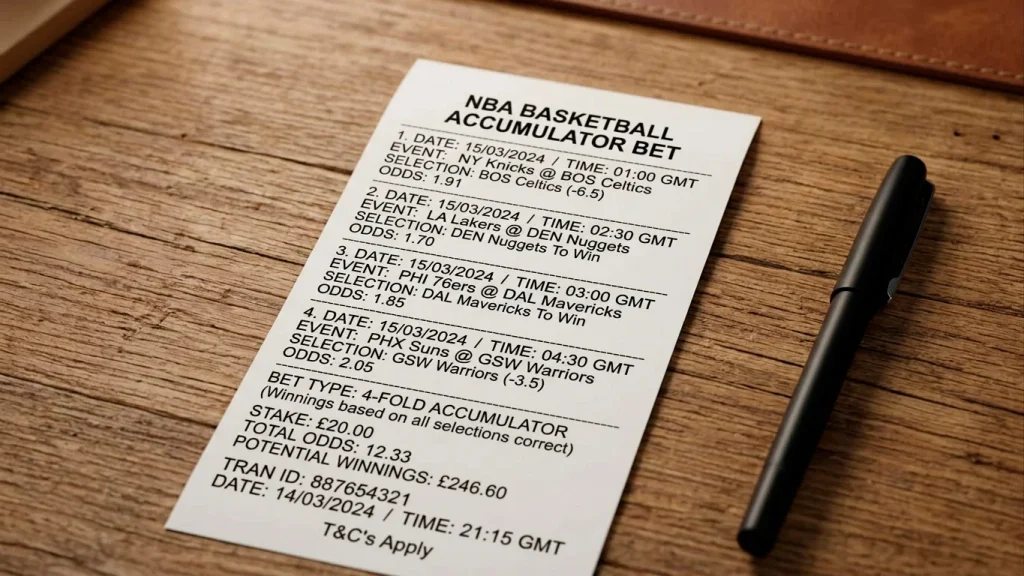
Compounded Bookmaker Margins vs Apparent Low-Risk Wagering Visuals
My first profitable NBA season ended on a Sunday in May when I cashed out a five-leg parlay for what felt, at the time, like a fortune. The total return was 22 times my stake. I posted it on a forum. Three people congratulated me. One reply said “you got lucky and now you’ll spend the next 20 parlays giving it back.” That person was right. Across the next two seasons of parlay-heavy betting, I gave back every penny of that win and more.
The painful truth about parlays is that they are the most heavily margined product in NBA betting. Bookmakers love them because the compounded margin is much higher than the headline odds suggest. Punters love them because the return on a small stake is dramatic when they hit. The combination is a classic mismatch — operator profit centre on one side, dopamine-driven small stakes on the other. This article is the practical breakdown of why parlay maths are punishing, when they can be justified, and what the right NBA parlay strategy actually looks like.
The compounded margin problem
A single NBA moneyline bet typically carries a bookmaker’s margin of 4 to 6 percent. That margin is the gap between fair odds and posted odds, paid by you in exchange for the privilege of betting. On a single bet, the margin is a manageable headwind. Across many single bets with skill, it can be beaten.
A parlay multiplies that margin geometrically. If you parlay four legs, each carrying a 5 percent margin, the combined margin is not 20 percent. It is 1 minus (0.95 to the fourth power), which equals 18.5 percent — close to 20 because the legs are small but not exactly. By the time you parlay six legs at 5 percent margin each, the combined margin is 26.5 percent. By eight legs, it is 33.7 percent. You are now betting a product where the house has built in over a third of all wagered money as expected profit. No amount of skill at the individual leg level overcomes a 33 percent house edge.
This compounding is the fundamental maths problem with parlays. Each leg is a small loss in expectation; the parlay multiplies the small losses into a large one. A punter who would never bet a single 33-percent-margin product happily bets eight-leg parlays carrying that exact margin. The packaging hides what is being sold.
Correlated parlays and same-game-parlay traps
Same-game parlays are the modern variant of this trap. The pitch is appealing — combine multiple bets on one game (LeBron over points, Lakers to win, total over) into a single ticket with attractive odds. The hidden mechanic is correlation. If LeBron scores a lot of points, the Lakers are more likely to win and the total is more likely to go over. The legs are positively correlated, and the bookmaker prices the parlay to capture both the explicit margin and the correlation premium.
This is not necessarily bad value if the correlations work in your favour and the book misprices them. There are situations where same-game parlays can offer genuine edges, particularly when the book’s correlation model is conservative. But the default same-game-parlay marketing flow leads recreational punters into combinations that are heavily margined exactly because the legs are correlated. The book knows the correlation. They price it.
The cleanest test is to price the same-game parlay’s implied probability against what the implied probability would be if the legs were independent. If the parlay pays significantly less than the independent-leg combination would, the operator is charging you for the correlation. Sometimes the charge is fair. Often it is overpriced. Reading correlated parlays without that test is paying for a structural premium without understanding what you are buying.
Variance and bankroll destruction
The other major problem with parlays is variance. A five-leg parlay with each leg priced at 1.80 has a combined decimal price of about 18.9. If each leg is a 50/50 coin flip in true terms, the combined true win probability is 1 in 32, or about 3.1 percent. That means a punter betting one of these parlays per night will lose 31 nights in a row, on average, between wins.
Thirty-one losing nights in a row will exhaust most recreational bankrolls long before the variance smooths out. Even a punter with skill at each individual leg faces a long run of losses while waiting for the parlay to hit. The classic parlay punter response is to chase — increasing stake size after losses to “make up for it.” This is the fastest path to ruin in betting. The maths of negative expectancy plus variance plus stake escalation is structurally bankrupt.
The correct response to parlay variance is to bet very small fractions of bankroll on each parlay, treat losses as expected, and never increase stake size to recover. In practice, almost nobody does this. The product is designed to be psychologically engaging precisely because of the variance. Each win feels disproportionate to the stake. The dopamine architecture of parlay betting is what makes the maths bearable for the punter and brutal for the bookmaker’s margin to apply.
When parlays actually make sense
There are narrow situations where NBA parlays carry genuine value.
The first is when you have multiple uncorrelated bets that you would place individually anyway, and the parlay return is large enough that the compounding works for you despite the margin. If you have a 5 percent edge on each of three independent bets, the parlay carries a combined edge of about 8 to 10 percent net of compounded margin. That is a positive expected value bet. The issue is that the variance is sharp, so position sizing has to be small.
The second is dog parlays in low-margin markets. Underdog moneylines often carry slightly thinner margins than favourite moneylines on the same matchup, because the operator’s risk is balanced on the favourite side. Parlaying two genuine value underdogs can produce a combined price that retains most of the individual edges. This is rare to find but it exists.
The third, and the one I use occasionally, is structured entertainment betting. A small fixed stake on a fun multi-leg parlay, sized so that losing 30 in a row would not affect bankroll meaningfully, sits within the bounds of a healthy betting hobby. The maths is bad. The dopamine is real. The point is to keep the dopamine portion small enough that the maths does not destroy you.
The parlay discipline that protects you
The discipline for sustainable parlay betting comes down to four rules.
First, cap the number of legs. Parlays of more than five legs have margins so heavy that even genuine edges on each leg get consumed by compounding. Three to four legs is the upper limit where the maths can still work.
Second, demand uncorrelated legs. Same-team correlations and same-night-team-quality correlations price into the parlay. If you cannot identify why the legs are independent, treat them as correlated and demand a price that reflects that.
Third, size very small. A parlay with a 30 percent compounded margin will run cold for months. Bankroll allocation per parlay should not exceed 0.5 to 1 percent. The Kelly criterion, applied honestly to parlay variance, produces stakes that feel uncomfortably small. That discomfort is the maths telling you the truth.
Fourth, track your parlay record separately from your single-bet record. The temptation to mentally include your big parlay win in your “overall performance” is strong. The honest accounting separates them. Parlays are a different product with a different risk profile, and they need a separate ledger. Over a season of separately-tracked parlay performance, almost every punter discovers their parlay strategy is a net loss that their single bets were quietly subsidising. The truth hurts but the bankroll preservation is worth it. The full structure of the sportsbook hold is the broader frame here — parlays are not a separate product, they are the same product packaged to look more attractive and priced to deliver more profit to the operator.
What"s the safest number of legs for an NBA parlay?
Three to four legs is the practical upper limit where compounded margin remains beatable. Above five legs the margin builds geometrically and the variance becomes severe. Many recreational punters bet eight or more legs, which is structurally a losing strategy regardless of leg-level skill.
Are same-game parlays better or worse than cross-game parlays?
Worse, on average. Same-game parlays carry both compounded margin and a correlation premium that the bookmaker prices to their advantage. Cross-game parlays are at least independent in their leg outcomes, even if the compounded margin is still heavy.
Can you make money from NBA parlays long-term?
Mathematically yes, in narrow cases where you have genuine independent edges on each leg and you size very small. In practice almost no one does this consistently. The product is designed to extract margin from recreational punters, and the variance keeps the maths feeling forgivable until the bankroll runs out.
Articles
Prepared by the NBA Stats For Betting editorial staff.
